Determine which projects are most important and time-sensitive.
Focus on One Major Project at a Time:
Choose one major project to focus on, such as finishing your novel or expanding your blog, and dedicate specific time to it each week.
Set Realistic Goals and Deadlines:
Break Down Large Tasks: Divide large projects into smaller, manageable tasks.
Set Specific, Achievable Deadlines: Assign deadlines to each task to create a sense of urgency and structure.
Create a Schedule:
Allocate Dedicated Time Slots: Set aside specific times each day or week for different projects.
Use a Planner or Digital Calendar: Keep track of your schedule and deadlines to stay organized.
Overcoming Procrastination
Address Self-Doubt:
Acknowledge Your Accomplishments: Remind yourself of your successes and the progress you’ve made.
Seek Feedback: Share your work with trusted colleagues or friends for constructive feedback to boost your confidence.
Minimize Distractions:
Create a Productive Workspace:
Find a quiet, organized space to work on your projects.
Limit Social Media and Unnecessary Interruptions: Use apps or tools to block distracting websites during your work sessions.
Use Productivity Techniques:
Pomodoro Technique: Work for 25 minutes, then take a 5-minute break. Repeat this cycle to maintain focus and avoid burnout.
Time Blocking: Dedicate specific blocks of time to different tasks throughout the day.
Consistency and Motivation
Establish Routines:
Morning or Evening Routines: Incorporate your projects into your daily routines, whether it’s early in the morning or after your workday.
Daily Writing Habit: Set a specific time each day for writing or working on your blog.
Stay Accountable:
Find an Accountability Partner: Share your goals with a friend or colleague who can check in on your progress.
Join Writing or Project Groups: Participate in groups or forums related to your interests for support and motivation.
Reward Yourself:
Celebrate Small Wins: Reward yourself for completing tasks and reaching milestones.
Balance Work and Personal Life: Ensure you have time for relaxation and activities you enjoy to avoid burnout.
By prioritizing your projects, setting realistic goals, and creating a structured schedule, you can manage your workload more effectively and make consistent progress. Remember to be kind to yourself and acknowledge your achievements along the way.
Happy New Year! I hope you are having a restful holiday and I wish you all the best for the new year.
I’ve recently discovered a simple practice that has the potential to shape the entire year—choosing a Word of the Year.
The idea is elegantly straightforward: select a single word that encapsulates the essence of what you want to manifest in the coming year. This word becomes your guiding light, a beacon that directs your focus, shapes your priorities, and fuels your journey. Some examples include: Renewal, Growth, Resilience, Balance, Harmony, or Transformation, but the posibilities are endless. You could even brainstorm by making lists or a word web before settling on your word.
The benefits of this practice are far-reaching. At the end of this post I’ll share the word I’ve chosen, why I’ve chosen it, and how I plan to use it to focus my goals. I will also invite you to share your word.
Here are some examples of how a single word might impact your year:
Renewal: A Fresh Start
“Every morning brings new potential, but only if you take the first step.”
Choosing ‘Renewal’ as your Word of the Year is an invitation to embrace fresh beginnings. It’s a commitment to shedding the old, obsolete layers and stepping into a revitalized version of yourself. This year, make it your mission to approach each day with a renewed sense of purpose and energy.
Growth: Cultivating Your Potential
“Like a tree, your growth is not defined by imperfections, but by the strength to keep reaching for the sun.”
Opting for ‘Growth’ signifies an unwavering commitment to personal and professional development. It’s about expanding your horizons, stepping out of your comfort zone, and allowing yourself the space to flourish. Cultivate the mindset of a lifelong learner, and watch as your world expands in ways you never thought possible.
Resilience: Bouncing Back Stronger
“In the face of adversity, resilience is your greatest ally.”
Resilience, your chosen word, becomes a source of strength when faced with challenges. Life is unpredictable, but your response to adversity is within your control. This year, let ‘Resilience’ be your armor, helping you bounce back from setbacks and emerge stronger than ever before.
Balance: Nurturing Harmony Within Chaos
“In the dance of life, find your rhythm and savor the harmony.”
‘Balance’ is a powerful word that resonates with the need to harmonize the various facets of your life. Juggling work, relationships, and personal well-being can be challenging, but by choosing ‘Balance,’ you commit to finding equilibrium. Strive to allocate time and energy to each aspect of your life, creating a symphony of fulfillment.
Harmony: Creating Synchronicity
“In the orchestra of life, let harmony be the melody that guides your actions.”
Selecting ‘Harmony’ is an acknowledgment of the interconnectedness of your goals and values. It’s about aligning your actions with your beliefs, fostering positive relationships, and creating a cohesive narrative for your life. Allow ‘Harmony’ to guide your decisions, bringing a sense of unity to your journey.
Transformation: Embracing Evolution
“To transform is to evolve; embrace the journey of becoming who you are meant to be.”
‘Transformation’ is a bold choice, representing the profound shifts you aspire to make. This word calls for embracing change, challenging the status quo, and evolving into the best version of yourself. Let ‘Transformation’ be the catalyst for growth and the driving force behind your pursuit of excellence.
How to Harness the Power of Your Word:
Reflect: Take a moment to reflect on the past year—its triumphs, challenges, and the lessons learned. Identify the themes or aspirations that resonate with where you are now and where you want to go.
Choose with Intention: Select your Word of the Year with purpose. It should be a word that inspires you, resonates with your goals, and encapsulates the essence of what you want to achieve. Trust your instincts; the right word will find you.
Visualize: Create a visual representation of your word. This could be a vision board, a piece of art, or simply a written statement. Place it where you’ll see it daily, serving as a constant reminder of your focus and aspirations.
Incorporate into Goal Setting: Align your goals with your chosen word. If ‘Growth’ is your word, set specific objectives that contribute to your personal and professional development. Let your word inform the direction of your goals.
Check-In Regularly: Regularly revisit your Word of the Year. Consider how it’s influencing your decisions, actions, and overall mindset. Use it as a touchstone to ensure alignment with your aspirations.
Celebrate Progress: Acknowledge and celebrate the progress you make throughout the year. Small victories are stepping stones to more significant achievements. Celebrate your journey and the person you are becoming.
Embrace the power of your chosen word, and watch as it transforms your year into a masterpiece of growth, resilience, balance, harmony, and, ultimately, transformation. This is your year—empower it with intention, purpose, and the transformative energy of your chosen word.
For my word of the year, I’ve chosen ABUNDANCE. For the past two years I’ve felt the constant constriction of LACK. Lack of time, lack of energy, lack of money. I’m determined this year to focus on what I WANT, not what don’t want.
Abundance means and abudance of time, energy, happiness, money, contentment, ideas, creativity, memories, and love.
If you share your word in the comments, I will create a custom blog post in the next week based on your word, sharing images, thoughts, ideas, and resources based on your word. I will also spend time each month revisiting my word and how it is impacting my year.
I have been giving a lot of thought to the idea of mindsets and why they are so important.
A mindset refers to a set of beliefs, attitudes, and assumptions that shape the way an individual perceives and interprets the world around them. It is essentially a mental framework or lens through which people view situations, make decisions, and respond to challenges. Mindsets can influence various aspects of life, including how individuals approach learning, handle setbacks, pursue goals, and interact with others.
For example, I was recently reading advice about fitness and nutrition, and it recommended visualing yourself as a fit, healthy person when making choices about what to eat. In other words, instead of thinking about having a list of restrictions (“I can’t have these french fries.”), think of yourself as a fit, healthy person who doesn’t eat french fries (“I don’t eat french fries.”) This may seem like silly semantics, or word games, but research shows it really works.
One of my most popular posts is The Creator Mindset, in which I discuss what it means to think like a content creator and develop a creator mindset. I’ve become convinced that changing your mindset is the most effective way to achieve your goals. Here is why mindsets are more important than goals.
A Creator Mindset:
ImprovesResilience: Having the right mindset helps build resilience by encouraging you to see challenges and setbacks as opportunities for learning and improvement. Instead of being discouraged by obstacles, those with a growth mindset are more likely to persevere and find solutions.
Embraces Learning and Development: A mindset shift towards growth fosters a love for learning. Instead of fearing failure, individuals with a growth mindset view it as a natural part of the learning process. This mindset encourages continuous improvement and development over time.
Increases Motivation and Effort: A belief that effort leads to improvement is a core aspect of a growth mindset. This perspective can increase motivation and effort, as individuals understand that their actions have a direct impact on their abilities and success.
Adapts to Change: In a rapidly changing world, adaptability is a valuable trait. A growth mindset facilitates adaptability by promoting openness to new ideas, experiences, and challenges. It allows individuals to see change as an opportunity for growth rather than a threat.
Enhances Self-Reflection: Changing your mindset involves becoming more aware of your beliefs and attitudes. This increased self-awareness allows for more effective self-reflection, enabling individuals to identify and challenge limiting beliefs that may be hindering their progress.
Leads to Long-Term Success: While setting goals is important, a fixed mindset can limit one’s ability to achieve those goals. A growth mindset, on the other hand, supports the sustained effort and learning required for long-term success. It’s not just about achieving specific goals but about continuously evolving and reaching new heights.
Over time, I have done a great deal of research into the concept of mindset, beginning with the work I did while earning my doctorate in Education and Curriculum Design, in which I learned how to motivate learners without using the traditional (and ineffective) cycle of punishments and external rewards. Once I realized the impact that developing a resilient mindset had on student motivation, I began turning those tools toward myself, working with a success coach, taking courses, and reading books that provided me with the insight and methods needed to be successful. After putting together a system that worked for me, I decided to develop the Creator Mindset course to share that system with you. I’ll be launching in early January. Here is a sneak peak of the course content:
If you’re already a content-creator or want to be one, this course will catapult you to the next level. If you’re a writer, teacher, or student, you will also find this course helpful for improving your motivation, outlook, and results.
Developing a creator mindset is about creating a foundation for achieving goals more effectively. A positive and growth-oriented mindset can serve as a powerful catalyst for personal and professional development, enabling individuals to navigate challenges, learn from experiences, and achieve sustained success.
If you’re interested in learning more about how developing the right mindset can be a powerful tool for achieving your goals, be sure to subscribe to ELA Source by entering your email below. As always, I NEVER share your email with anyone, and I don’t spam your inbox.
You may have noticed that I’ve missed a few days here and there this month. My 30-day challenge has had a few blips, but I don’t consider it a failure, and still plan to keep going and post my stats at the end of this month and every month.
Instead, I see those blips as a learning experience. I’ve left too much up to chance with my blogging, and I’ve failed to devlelop a cohesive plan for the month of September. As a teacher, I realize the importance of planning–I couldn’t live without structured lesson planning, but it’s also important for writers and content creators.
I’m publishing this on Saturday night because Sundays are my favorite days to plan. Tomorrow I will share some ideas for you about effective planning, and the best planning strategies that work for me, from the pros and cons to paper vs. digital planners, to whether or not you should do daily, weekly, or month planning layouts.
Planning is also a form of self-care for me, because it helps me feel more in control of my time, helps keep anxiety at bay, and reduces the nasty surprises and panicked Monday mornings when I’ve gotten behind on my tasks.
I haven’t blogged here in a while, mainly because I’ve been getting my kids ready for their school year (I have one in middle school and one in high school) and I’ve also been working with new teachers to help them prepare for the coming year. This can indeed be a stressful and anxiety-inducing time for teachers.. Here are some strategies both new and experienced teachers can use to overcome and prepare for the beginning of the school year anxiety and stress:
Set Realistic Expectations: Understand that the beginning of the school year can be overwhelming, but it’s important to set realistic expectations for yourself and your students. Rome wasn’t built in a day, and it’s okay if everything isn’t perfect from the very start.
Plan Ahead: Create a detailed plan for the first few weeks, including lesson plans, classroom setup, and administrative tasks. Having a clear roadmap can help alleviate anxiety by giving you a sense of control and direction.
Organize Your Space: A well-organized classroom can significantly reduce stress. Take time to arrange desks, materials, and resources in a way that is conducive to learning and easy to navigate.
Connect with Colleagues: Reach out to fellow teachers, both experienced and new, to share ideas, tips, and experiences. Collaborating with others can provide a sense of camaraderie and the opportunity to learn from one another.
Self-Care: Prioritize self-care and well-being. Make sure you’re getting enough rest, eating healthily, staying hydrated, and engaging in activities you enjoy outside of work. Taking care of your physical and mental health is essential.
Set Boundaries: It’s easy for teachers to overwork themselves, especially during the start of the year. Set clear boundaries between work and personal time to prevent burnout.
Practice Mindfulness: Incorporate mindfulness techniques into your routine, such as deep breathing, meditation, or yoga. These practices can help you stay centered and reduce stress.
Celebrate Small Wins: Acknowledge and celebrate even the smallest accomplishments during the beginning of the school year. Each step forward is a reason to be proud.
Reflect and Adjust: Regularly reflect on your progress and adjust your plans as needed. This ongoing assessment can help you stay on track and make necessary improvements.
Seek Support: If your anxiety and stress become overwhelming, don’t hesitate to seek support from a counselor, therapist, or support group. Your mental well-being is a priority.
What are your favorite go-to strategies for getting ready for the new year? Or, if you’re not a teacher, some strategies you use to manage stress or plan your week.
Brain dumping is a technique that involves taking all the thoughts, ideas, tasks, and information swirling around in your mind and transferring them onto paper or a digital document. It’s a way to externalize and organize your thoughts, essentially emptying your brain of its clutter.
The process of brain dumping typically involves writing down or typing out everything that comes to mind, without any specific order or structure. You simply let your thoughts flow freely, capturing them on paper. The idea is to create a comprehensive list or document that encompasses all your mental clutter.
The benefits of doing a brain dump are numerous:
Mental clarity: By externalizing your thoughts, you can clear mental space and gain a clearer perspective on your ideas and tasks. It helps reduce mental clutter and allows you to focus better on the things that matter.
Stress reduction: The act of transferring your thoughts onto paper can be cathartic and provide a sense of relief. It can alleviate anxiety and stress by unburdening your mind from constantly trying to remember or juggle multiple thoughts simultaneously.
Enhanced organization: Brain dumping allows you to capture all your thoughts and tasks in one place. This makes it easier to identify priorities, create to-do lists, and organize your ideas. You can then review and categorize the information, leading to better planning and improved productivity.
Idea generation: When you have a multitude of thoughts floating in your mind, it can be challenging to connect the dots or see the bigger picture. Brain dumping can help you identify patterns, make connections between ideas, and spark new insights and creativity.
Improved memory: Writing things down helps solidify information in your memory. By capturing your thoughts on paper, you create a reference point that you can revisit later, reducing the need to rely solely on your memory.
Problem-solving: Brain dumping can be an effective problem-solving tool. By getting everything out of your head, you can examine your thoughts and challenges more objectively. This external perspective often leads to fresh insights and potential solutions.
Overall, brain dumping is a valuable technique for decluttering your mind, gaining mental clarity, and improving your overall productivity and well-being. It’s a simple and accessible method that can be tailored to individual preferences, whether through traditional note-taking, digital tools, or even voice recording.
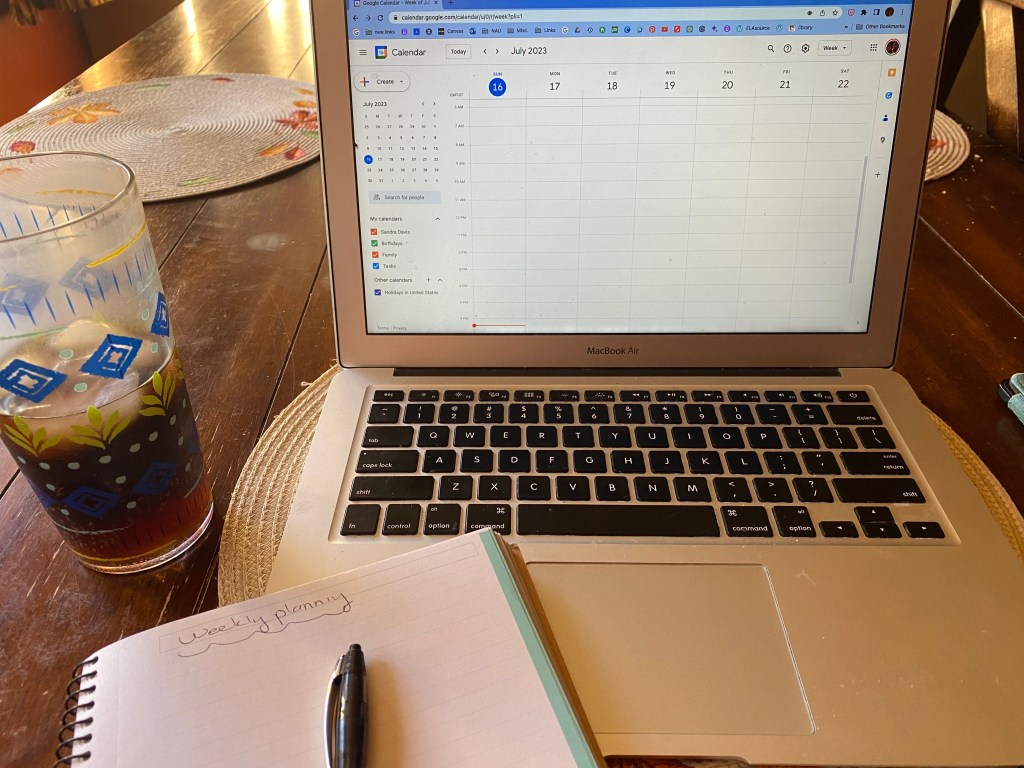
I discovered a few months ago that the cure for the Sunday Scaries (Sunday night anxiety) is to plan for the coming week. I’m usually too anxious to enjoy Sunday afternoons anyway, and this gives me an outlet for my restlessness and allows me to sleep better on Sunday night. It also makes the work week go much more smoothly.
Right now I’m on summer vacation, but I’ve realized that the first week of school will be here before I know it (sorry), and I want to get a jump on planning for the coming year. I also have personal projects that I want to complete before my semester begins (mainly my novel), so I’ve decided that since we’re done traveling for the summer I’m going to try to give my days a bit more structure by creating a very loose schedule and writing down some goals.
Research shows that people who WRITE DOWN THEIR GOALS and MAKE A PLAN, are much more likely to accomplish those goals.
I’ve been reading some productivity books and blogs, and one of the number one recommendations is to put your to-list into your calendar. SCHEDULE YOUR TO-DO LIST. Although I’ve always kept a paper calendar, I’ve decided to give Google Calendar a try. Before creating my schedule, I’m going to a brain dump. I’ll write more on doing a brain dump tomorrow, since that turns out to also be the first step in creating an online course.
Happy Sunday night and happy planning! Here’s to a great week.
I’m in the process of learning how to create online courses for the general public. I’m currently taking a Udemy course called “How to Create In-Demand Online Courses.” This is to learn how the nuts and bolts of creating an online course, but will also benefit me in my professional life, since as a professors I also teach an online course. I’m hoping to both improve as a teacher and a content creator, but also pass along that knowledge to you.
As a full-time college professor, former middle school and high school teacher, and someone who has a doctorate in curriculum design and is in the process of learning game design and digital marketing (as fun hobbies, lol), I feel uniquely qualified to help you on your journey to becoming a better teacher or content creator, or to get started on a side-hustle.
One of my biggest frustrations as a newbie content-creator is that so many of the resources out there are loaded with generic bullshit, click bait, and useless platitudes. For example, many of these resources will tell you to “choose a niche” or “know your audience” without really giving you the nitty gritty details of HOW to do that.
That’s why I’m doing a fun experiment and bringing you along for the ride. I’m going to explore several different types of content creation, from blogging to YouTube to TpT (Teachers Pay Teachers) to Fiverr and walk you through the step-by-step details of EXACTLY what I’m doing, how it’s going, what’s working and not working, and how to see results.
In addition to doing 30 days of blogging (which I’ll report on soon), I’m also learning how to create a course and then I’m going to create a post a course. Today I’m going to learn from Udemy and several other online resources, and then tomorrow I will start creating my course.
I would LOVE to hear suggestions for things you’d like to see me build a course on. Taking into consideration my experience and expertise, some options are:
I’ve recently started working on prep for a free online course (Coming Soon!) and for my fall classes, and I wasn’t happy with most of the course planning or unit planning guides I found online, so I created my own. I’ve included it here as a printable PDF and also a fully editable MS Word Document. Feel free to take this and use it any way you like!
Whether you’re creating online courses as a content creator, or in-person lesson plans and curriculum as a teacher, many of the same curriculum design principles apply.
Create a Plan
Creating an instructional plan is essential for organizing, guiding, and optimizing the teaching and learning process. It supports both teachers and students in achieving desired learning outcomes, managing time and resources effectively, and providing differentiated instruction to meet the needs of all students.
Determine Your Learning Objectives
The most important part of creating a plan is determining your learning objectives. Many teachers balk at this because they’ve been to terrible PD sessions with too many buzz words. Just think of Learning Objectives as your GOALS for the course. What is it that you want students to learn, gain, or walk away with?
Keys to Engaging Design
Here are three of the most important elements of engaging design:
1. Small wins
Small wins are simple activities/challenges in your course that give your students a sense of accomplishment and confidence. They keep students excited about learning and refuel their motivation.
Include small wins throughout the course, and award your learners with badges and congratulatory pop-up messages every time they complete a challenge.
2. Scaffolding
Scaffolding is layering the learning experience, so students build on the concepts they already understand. Scaffolding requires that you gradually layer from simple concepts to more challenging ideas by telling students how this new information fits into what they already know. Keep in mind that scaffolding is an excellent way to prevent cognitive overload.
3. Active learning
It is not enough to include dozens of videos of yourself speaking into the camera or do a lot of screen recording. Learners must DO something to learn. Use quizzes, assignments, and interactive elements to transform learners from passive to active. Social activities like course discussions and live workshops are also incredibly effective and engaging.











 ELA Source
You must be logged in to post a comment.