The Profound Benefits of Prioritizing the Learning Process over the Final Product


In a world driven by outcomes and results, there is a growing need to shift our perspective from the end goal to the journey itself. Focusing on the process of learning or creation, rather than fixating solely on the final product, brings about a multitude of benefits. This shift not only fosters a healthier learning environment but also helps to mitigate issues such as cheating, plagiarism, overreliance on AI, anxiety, and procrastination.

  1. Encourages Genuine Understanding: Prioritizing the learning process promotes a deeper and more genuine understanding of the subject matter. Instead of seeking shortcuts to achieve a polished final product, individuals engage with the material, grapple with challenges, and develop a comprehensive comprehension that goes beyond mere surface-level knowledge.

  2. Cultivates Critical Thinking Skills: The journey of learning involves navigating through complexities, problem-solving, and critical thinking. Focusing on the process encourages individuals to analyze information, connect concepts, and apply their knowledge in real-world scenarios. This cultivation of critical thinking skills is essential for personal and professional growth.

  3. Reduces the Temptation of Cheating and Plagiarism: When emphasis is placed on the process, the need for shortcuts diminishes. Cheating and plagiarism often stem from a fixation on the final product, pushing individuals to cut corners to meet deadlines or expectations. By valuing the journey, the pressure to resort to unethical practices decreases, promoting academic integrity.

  4. Mitigates Overreliance on AI: While AI, such as ChatGPT, can be a valuable tool, an overreliance on it can hinder individual cognitive development. Focusing on the learning process allows individuals to grapple with challenges independently, enhancing their problem-solving skills and reducing dependency on external sources.

  5. Alleviates Anxiety: The pursuit of perfection in the final product can lead to heightened anxiety. Shifting the focus to the process eases the burden of unrealistic expectations, allowing individuals to embrace mistakes as opportunities for learning. This shift in mindset fosters a healthier relationship with learning and creativity.

  6. Combats Procrastination: The overwhelming pressure associated with producing a flawless final product can often lead to procrastination. By breaking down tasks into manageable steps and valuing the learning process, individuals are more likely to approach their work with a sense of curiosity and enthusiasm, reducing procrastination tendencies.

  7. Fosters a Growth Mindset: Emphasizing the learning process aligns with the principles of a growth mindset. Individuals with a growth mindset view challenges as opportunities for growth rather than insurmountable obstacles. This mindset shift promotes resilience, adaptability, and a positive attitude towards learning and creativity.

In a society that often prioritizes outcomes, it is crucial to recognize the profound benefits of focusing on the process of learning or creation. By embracing the journey, individuals can develop a deeper understanding, cultivate critical thinking skills, and mitigate issues such as cheating, plagiarism, overreliance on AI, anxiety, and procrastination. This shift not only enhances individual development but also contributes to the creation of a more ethical, resilient, and creative society.

Planning and Creating Engaging Course Content


Whether you’re creating online courses as a content creator, or in-person lesson plans and curriculum as a teacher, many of the same curriculum design principles apply.

Create a Plan

Creating an instructional plan is essential for organizing, guiding, and optimizing the teaching and learning process. It supports both teachers and students in achieving desired learning outcomes, managing time and resources effectively, and providing differentiated instruction to meet the needs of all students.

Determine Your Learning Objectives

The most important part of creating a plan is determining your learning objectives. Many teachers balk at this because they’ve been to terrible PD sessions with too many buzz words. Just think of Learning Objectives as your GOALS for the course. What is it that you want students to learn, gain, or walk away with?

Keys to Engaging Design

Here are three of the most important elements of engaging design:

1. Small wins

Small wins are simple activities/challenges in your course that give your students a sense of accomplishment and confidence. They keep students excited about learning and refuel their motivation.

Include small wins throughout the course, and award your learners with badges and congratulatory pop-up messages every time they complete a challenge.

2. Scaffolding

Scaffolding is layering the learning experience, so students build on the concepts they already understand. Scaffolding requires that you gradually layer from simple concepts to more challenging ideas by telling students how this new information fits into what they already know. Keep in mind that scaffolding is an excellent way to prevent cognitive overload.

3. Active learning

It is not enough to include dozens of videos of yourself speaking into the camera or do a lot of screen recording. Learners must DO something to learn. Use quizzes, assignments, and interactive elements to transform learners from passive to active. Social activities like course discussions and live workshops are also incredibly effective and engaging.

Should We Rethink Everything?


Everyone is exhausted. My middle school-aged children at home (ages 11-14) hate school and do not want to go. Some of that is end-of-year burnout, some of that is middle school (it’s a tough age), but parents of all ages are feeling it. As a college teacher, I will tell you that the students in my classrooms are tired, bored, ill-prepared, and behind. And this is a group of students who want to be teachers! If my 400-level English Education majors are struggling this much, I can’t imagine what teachers of college freshman are dealing with.

Teachers of every grade-level are feeling burnout. There is so much anger and blame. Whose fault is it? WHOSE FAULT IS IT? Could be:

  1. The screens
  2. Social media
  3. CHAT GPT
  4. Racism
  5. The parents
  6. The schools
  7. The teachers
  8. THE PANDEMIC
  9. The economy
  10. The environment
  11. The guns
  12. The Democrats
  13. The Republicans

For elementary school teachers it’s almost always the parents. For middle and high school teachers, it’s the elementary school teachers, for the college teachers it’s the high school teachers. And it’s always the screens. If we just take away the screens, things will improve.

I’m not so sure.

As someone who has school-aged children, who spends a good part of her work week visiting and observing in the public schools (I do research, help teachers, and supervise student teachers), and who reads teaching and professor forums, what I DO SEE is a generation of exhausted professionals who are clinging to out-dated teaching methods. It’s nobody’s fault. We were trained to teach this way.

However, I have always felt strongly that taking away technology is not the solution. Barring iPhones and ChatGPT from the classroom to preserve outdated methods feels fundamentailly wrong to me.

I don’t know the answer. When I’m really struggling I turn to the fundamentals of constructivist teaching, which I have learned again and again, while earning my doctorate, through my own teaching, and through continuing to read and do research into pedagogy, is the most effective method. People scoff at constructivism as a buzz word because they don’t understand it.

At it’s very core, constructivism simply means ACTIVELY INVOLVING STUDENTS IN THEIR OWN LEARNING.

We scoff at “ACTIVE LEARNING” because it’s a phrase that is used all the time without any real mearning or purpose. All ir means is simplly asking the students to take an action of some kind. It iis n the ACTION that the learning happens.

Students are not good at listening passively. None of us are. Things go in one ear and out the other. Instead of passive lecturing, require that students seek out the information themselves and fill out a graphic organizer. Ask them to confer with their peers. Give them ample amounts of time to socialize, but a very limited amount of time to complete a task.

For example, present a new concept in a short period of time, just a few minutes. Present the material orally as well as visually. Have studets take notes using a graphic organizer to guide their notetaking. Then, have students work in groups to apply the concept to a problem. Have them actively practice or apply the concept. Have the groups work together to write on the white board or fill out a Google Slide. Give each student an active role. One student writes down the answers, one student will present to the class, one student keeps track of time.

Walk around while groups are working. You have to walk around. As soon as you sit down, students will go off the rails. Is it tiring to be on your feet all day? Of course, but it’s actually less exhausting than dealing with an entire classroom full of students who aren’t doing anything. You can sit down while the groups present. Also, wear comfortable shoes. Get a fitbit.

When the time is up, have groups present what they learned. Call on students by name. Ask them to explain their process. Get them used to thinking out loud in the classroom. Get them comfortable with explaining their thinking even when they don’t understand. It’s okay if they don’t understand.

This is just the start. There are other approaches, other ways of teaching. Remember, there is no one approach that will work with every student. I will be using this blog to explore different approaches and different methods, as well as providing resources, such as Power Point slides, graphic organizers, group work forms, and self-reflection tools to help making teaching easier.

Research Projects: Why the Process is More Important than the Final Product


Research projects are an essential part of the English and Language Arts classroom. These types of projects allow students to develop critical thinking skills, improve their writing, and gain a deeper understanding of the subject they are studying. By focusing on the process of research, rather than just the end product, teachers can help students become more confident and skilled writers.

On the other hand, simply providing students with a large project prompt and little guidance can often result in unweildy papers that contain large amounts of cut-and-pasted information, irrelevant quotes and blocks of text, and plaยทgiaยทrized passages.

One of the key benefits of focusing on the research process is that it helps students develop critical thinking skills. When students are given the opportunity to conduct their own research, they are forced to think for themselves and evaluate the credibility of the sources they are using. This can be a challenging task, but it is an important part of the learning process. By teaching students how to evaluate sources, teachers can help them become more discerning readers and writers.

Another benefit of focusing on the process of research is that it can improve students’ writing skills. When students are given the opportunity to conduct their own research, they are exposed to a wide range of information and ideas. This can help them develop their own ideas and arguments, which they can then use to improve their writing. By focusing on the process of research, teachers can help students become more confident and skilled writers.

Finally, focusing on the process of research can help students gain a deeper understanding of the subject they are studying. When students conduct their own research, they are not simply regurgitating information that has been presented to them by their teacher or a textbook. Instead, they are actively exploring the topic and forming their own conclusions. This can help them develop a more nuanced and sophisticated understanding of the subject.

In conclusion, the process of research is an essential part of the writing classroom. By focusing on this process, teachers can help students develop critical thinking skills, improve their writing, and gain a deeper understanding of the subject they are studying. By providing students with the opportunity to conduct their own research, teachers can help them become more confident and skilled writers.

Classroom activties for students learning the research process:

  1. Brainstorm topic ideas in small groups
  2. Make a mindmap
  3. Develop a list of key words
  4. Find and evaluate at least 3-5 sources on your topics
  5. Learn the difference between primary and secondary sources
  6. Compare the results of different search engines
  7. Take notes on index cards
  8. Write a thesis statement
  9. Make and outline
  10. Give a short talk on your research process and what you’ve learned about your topic so far

The Differences between Gamification and Game Design in the Classroom


Gamification and game design are two strategies that are often used in education to engage and motivate learners. While they may seem similar at first glance, there are some key differences between the two approaches.

Gamification is the use of game-like elements, such as points, badges, and leaderboards, in a non-game context to encourage certain behaviors or actions. In education, this might involve using a points system to reward students for completing assignments, participating in class, or achieving certain milestones. The goal of gamification is to make learning more fun and engaging by adding elements of competition and reward.

Game design, on the other hand, involves the creation of actual games or game-like experiences with a specific learning objective in mind. These games are designed to teach specific skills or knowledge, and are often more complex and immersive than gamified learning activities. Game design requires a deep understanding of game mechanics and the ability to create engaging and challenging experiences for learners.

One key difference between gamification and game design is the level of complexity. Gamification typically involves the use of simple game-like elements, such as points and badges, to motivate learners. Game design, on the other hand, involves the creation of entire game experiences, which may be much more complex and require more sophisticated game mechanics.

Another difference is the focus of the two approaches. Gamification is often used to motivate learners and encourage certain behaviors, while game design is focused on teaching specific skills or knowledge. This means that gamification is often used as a supplement to traditional instruction, while game design is more likely to be used as the primary method of teaching.

While gamification and game design are both strategies that can be used in education to engage and motivate learners, they are distinct approaches with some key differences. Gamification involves the use of simple game-like elements to encourage certain behaviors, while game design involves the creation of complex and engaging game experiences to teach specific skills or knowledge.

Five Ways to Promote Student Autonomy


As educators, one of our main goals is to help our students become independent and self-directed learners. But how can we do that?

One way is to promote student autonomy in the classroom. This means giving students the opportunity to make their own decisions and choices about their learning.

Here are five ways you can promote student autonomy in your classroom:

  1. Offer choices: Give students the opportunity to choose the topic they want to learn about, the project they want to work on, or the group they want to work with. This allows them to take ownership of their learning and feel more invested in the process. Encourage students to take ownership of their learning by providing them with choices and allowing them to make decisions about their assignments and projects.

  2. Encourage self-reflection: Help students to think about their own learning and progress. Encourage them to set goals for themselves and reflect on their progress towards achieving those goals. This will help them to become more self-aware and take responsibility for their own learning.

  3. Foster independence: Encourage students to take charge of their own learning and to seek out help when they need it. This could mean setting up a resource center where students can access books and other materials, or providing opportunities for students to work on their own or in small groups.

  4. Provide regular feedback to students on their progress and encourage them to reflect on their own learning and development.

  5. Continuously assess and evaluate your teaching methods to identify what is working and what can be improved, and make changes as needed to support student autonomy.

Self-Determination Theory and Student Motivation

What is Self-Determination Theory?

Self-determination theory refers to a person’s ability to make choices and manage their own life. Being self-determined means that you feel in control, rather than being controlled by others.

Self-determination theory plays an important role in mental health and well-being. Promoting self-determination in your classroom not only motivates students, but leads to better learning outcomes. It is also an emerging best practice when working with students who are not neurotypical or who have learning or behavioral difficulties.

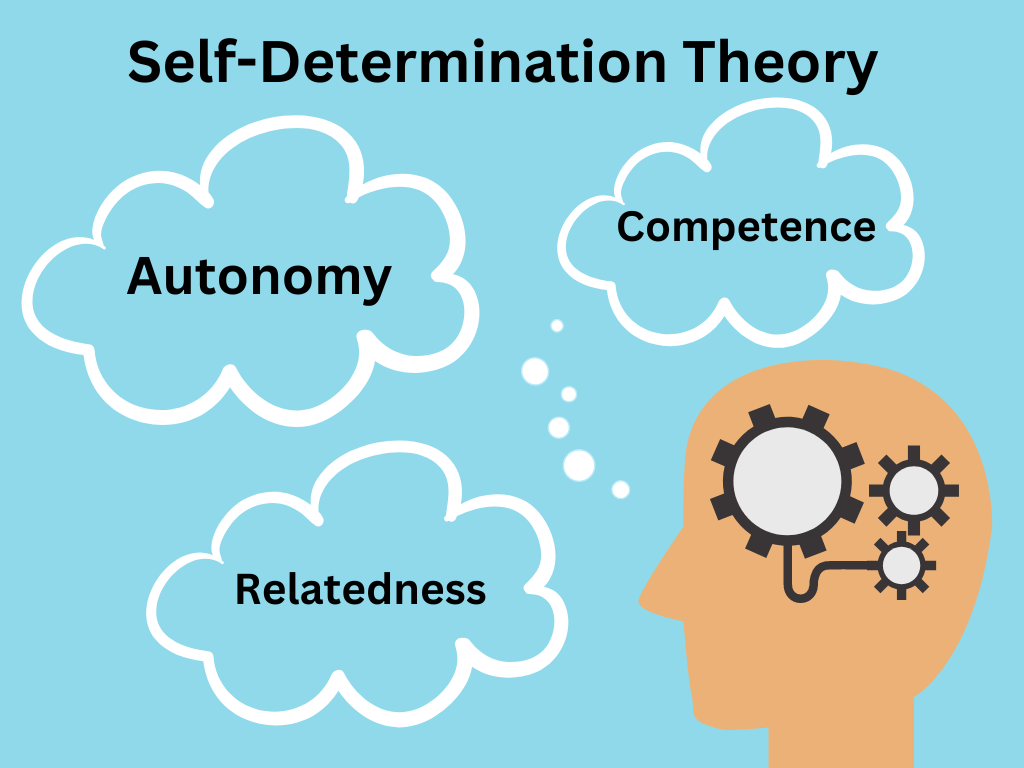
Self-determination theory focuses on three basic psychological needs:

Autonomy: A desire to feel in control.

Competence: A sense of accomplishment that builds confidence in one’s ability to learn.

Relatedness: A desire to belong and feel connected to others.


Self-Determination Theory in the Classroom

Teachers can cultivate self-determination theory in the classroom and increase student motivation by working to increase student autonomy, competence, and relatedness.

Self-determination theory provides a framework for helping teachers foster student motivation and engagement, as well as improving learning outcomes.

This approach will transform the way you think about teaching, student motivation, and course design and preparation.

Tips for Creating Self-Determination in the classroom:

In my next post, I will go over ways to faciliate student autonomy, improve competence and confidence, and foster relatedness and connectedness in your classroom and curriculum. Be sure to follow my blog to receive updates in your inbox.

Lesson Planning with Bloom’s Taxonomy

Bloom’s Taxonomy is a tool that you can use to help determine the levels of thinking you’re asking students to do, from simply remembering to understanding to applying and creating. This can give you insight into how to assess student learning and how to push students in higher-order thinking. Building upon each level in your lesson plans will guide students to think in increasingly more sophisticated ways.

I’ve used Bloom’s Taxonomy for years and have always found it helpful, but when I went looking for resources to share with my students I was surprised at how many videos and articles implied that teachers should include every level of Bloom’s Taxonomy in all of their lesson plans.

NOT TRUE!

How should you use Bloom’s Taxonomy in lesson planning?

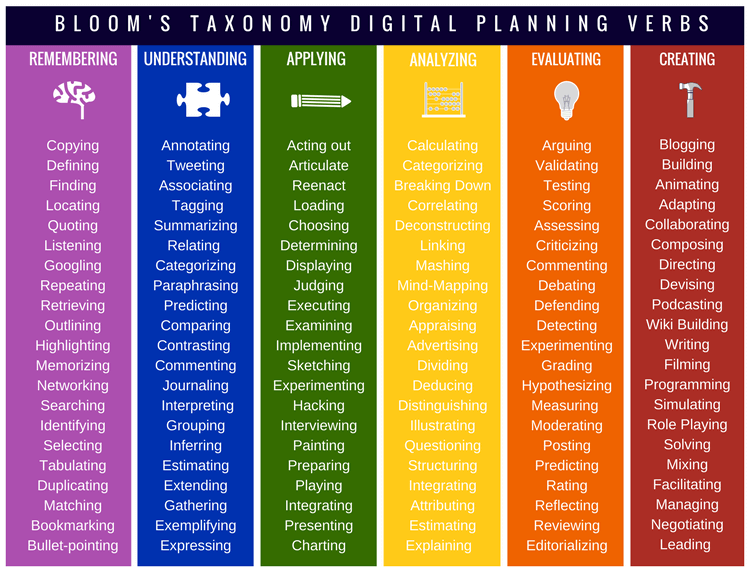
One way is to think about the learning objectives for your lesson. What are you asking students to do, and what do you want them to be able to do at the end of the lesson? It can be helpful to see how your learning objectives align with Bloom’s Taxonomy by looking at the planning verbs below, NOT to make sure you’re hitting every level (not every skill needs to be taught and assessed at every level), but to help make you aware of what level of the taxonomy your lesson is hitting.

For example, if you are always asking students to identify and define key terms, you might want to think about ways to help them learn to apply those terms. Students may be able to define the parts of speech, but are they then able to use them in a sentence? Students may be able to identify examples of characterization and setting in a piece of literature, but are they able to create their own characters and describe the setting in their stories?

I’ve included a table of helpful planning verbs below. You can also download a free planning table HERE.

Teach with Puzzles: 5 Free Puzzle Creation Tools for Teachers

Most teachers have used puzzles in their classroom at one time or another, but did you know that puzzles are not only engaging, but beneficial learning tools?

Puzzles strengthen the connections between brain cells, and create new connections for improved cognitive speed. 

Puzzles require students to see things simultaneously in terms of parts and wholes. They require both logic and creativity. As different regions of the brain work together to achieve the best results, the brain trains itself to integrate different types of thinking for long-term benefits.

The following free tools and resources can help teachers make their own puzzles, from word search and crossword puzzles to jigsaw puzzles and secret codes.

Discovery Education Puzzle Maker

https://puzzlemaker.discoveryeducation.com

Instant Online Puzzle Maker

https://www.puzzle-maker.com

Crossword Puzzle Maker for Teachers

https://worksheets.theteacherscorner.net/make-your-own/crossword

Free Puzzle Piece Template at Teachers Pay Teachers

https://www.teacherspayteachers.com/Product/Free-Puzzle-Piece-Templates-Creative-Clips-Digital-Clipart-707940

Free Puzzle Decoder Wheel

https://www.teacherspayteachers.com/Product/FREE-Puzzle-Decoder-Template-Set-Zip-A-Dee-Doo-Dah-Designs-3434484

Using Graphic Organizers

I’ve been doing a lot of research into active vs. passive learning lately in preparation for my fall teaching.

What is active vs. passive learning?

Active learning simply means that students literally take an action while learning, more formally it means that students take an active role in the learning process. But what does that look like in the classroom? In an active learning classroom, the students are not just taking notes, but are taking guided notes, are stopping to discuss and reflect, and are working collaboratively to learn concepts and solve problems. When students are learning passively, they are simply present and listening to a lecture.

Active Learning and Graphic Organizers

One strategy that helps with promoting active learning is the use of graphic organizers. Here is a great YouTube video with explains what graphic organizers are and how they promote active learning:

Here is resource on active learning from the University of Minnesota:

https://cei.umn.edu/active-learning

For more on active vs. passive learning and graphic organizers, be sure to follow the blog.