Research Projects: Why the Process is More Important than the Final Product


Research projects are an essential part of the English and Language Arts classroom. These types of projects allow students to develop critical thinking skills, improve their writing, and gain a deeper understanding of the subject they are studying. By focusing on the process of research, rather than just the end product, teachers can help students become more confident and skilled writers.

On the other hand, simply providing students with a large project prompt and little guidance can often result in unweildy papers that contain large amounts of cut-and-pasted information, irrelevant quotes and blocks of text, and plaยทgiaยทrized passages.

One of the key benefits of focusing on the research process is that it helps students develop critical thinking skills. When students are given the opportunity to conduct their own research, they are forced to think for themselves and evaluate the credibility of the sources they are using. This can be a challenging task, but it is an important part of the learning process. By teaching students how to evaluate sources, teachers can help them become more discerning readers and writers.

Another benefit of focusing on the process of research is that it can improve students’ writing skills. When students are given the opportunity to conduct their own research, they are exposed to a wide range of information and ideas. This can help them develop their own ideas and arguments, which they can then use to improve their writing. By focusing on the process of research, teachers can help students become more confident and skilled writers.

Finally, focusing on the process of research can help students gain a deeper understanding of the subject they are studying. When students conduct their own research, they are not simply regurgitating information that has been presented to them by their teacher or a textbook. Instead, they are actively exploring the topic and forming their own conclusions. This can help them develop a more nuanced and sophisticated understanding of the subject.

In conclusion, the process of research is an essential part of the writing classroom. By focusing on this process, teachers can help students develop critical thinking skills, improve their writing, and gain a deeper understanding of the subject they are studying. By providing students with the opportunity to conduct their own research, teachers can help them become more confident and skilled writers.

Classroom activties for students learning the research process:

  1. Brainstorm topic ideas in small groups
  2. Make a mindmap
  3. Develop a list of key words
  4. Find and evaluate at least 3-5 sources on your topics
  5. Learn the difference between primary and secondary sources
  6. Compare the results of different search engines
  7. Take notes on index cards
  8. Write a thesis statement
  9. Make and outline
  10. Give a short talk on your research process and what you’ve learned about your topic so far

Self-Care During the Winter Months


It’s completely normal to feel a bit down during the winter months, when the days are shorter and the weather is colder. But there are things you can do to avoid feeling depressed and maintain your mental well-being. Here are some suggestions for stayting positive during the winter months:

1. Enjoy the season. Winter has its own beauty and charm. Take time to appreciate the holiday lights and the coziness of being inside on a cold day.

2. Get some sunlight. Natural sunlight can help boost your mood and energy levels, so try to get outside for at least a few minutes each day, even if it’s just to take a quick walk around the block.

3. Move your body. Exercise has been shown to improve mood and reduce stress, so try to incorporate some form of physical activity into your daily routine. This could be as simple as taking a walk, doing some yoga, or going to the gym.

4. Stay connected. It’s easy to feel isolated during the winter months, but staying connected with friends, family, and loved ones can help boost your mood and prevent feelings of loneliness. Consider hosting a game night, going to a movie, or inviting friends over for dinner.

5. Take care of yourself. Winter can be a busy time, but it’s important to make time for self-care. This could include taking a relaxing bath, getting a massage, or simply curling up with a good book

Remember, it’s okay to feel a bit down during the winter, but there are things you can do to avoid feeling depressed. By incorporating these suggestions into your daily routine, you can maintain your mental well-being and enjoy the winter months.

The Differences between Gamification and Game Design in the Classroom


Gamification and game design are two strategies that are often used in education to engage and motivate learners. While they may seem similar at first glance, there are some key differences between the two approaches.

Gamification is the use of game-like elements, such as points, badges, and leaderboards, in a non-game context to encourage certain behaviors or actions. In education, this might involve using a points system to reward students for completing assignments, participating in class, or achieving certain milestones. The goal of gamification is to make learning more fun and engaging by adding elements of competition and reward.

Game design, on the other hand, involves the creation of actual games or game-like experiences with a specific learning objective in mind. These games are designed to teach specific skills or knowledge, and are often more complex and immersive than gamified learning activities. Game design requires a deep understanding of game mechanics and the ability to create engaging and challenging experiences for learners.

One key difference between gamification and game design is the level of complexity. Gamification typically involves the use of simple game-like elements, such as points and badges, to motivate learners. Game design, on the other hand, involves the creation of entire game experiences, which may be much more complex and require more sophisticated game mechanics.

Another difference is the focus of the two approaches. Gamification is often used to motivate learners and encourage certain behaviors, while game design is focused on teaching specific skills or knowledge. This means that gamification is often used as a supplement to traditional instruction, while game design is more likely to be used as the primary method of teaching.

While gamification and game design are both strategies that can be used in education to engage and motivate learners, they are distinct approaches with some key differences. Gamification involves the use of simple game-like elements to encourage certain behaviors, while game design involves the creation of complex and engaging game experiences to teach specific skills or knowledge.

Self-Determination in the Writing Classroom


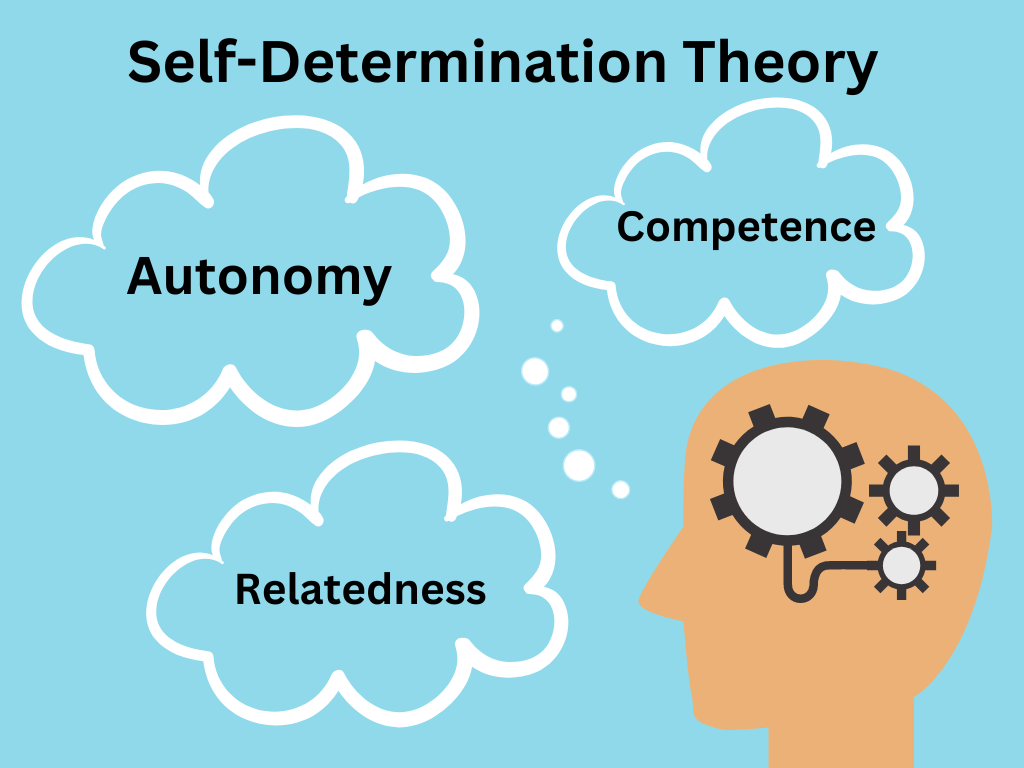
Self-determination theory is a psychological theory that explains the motivation behind human behavior. It suggests that people have a basic need for autonomy, competence, and relatedness, and that satisfying these needs is essential for psychological well-being and optimal functioning.

In the writing classroom, these three needs can be particularly important for student success and motivation.

Autonomy refers to the feeling of being in control of one’s own actions and decisions. In the writing classroom, providing students with choices and allowing them to take ownership of their own learning can foster a sense of autonomy and increase their motivation to write.

For example, giving students the option to choose their own writing topics or allowing them to collaborate with their peers on a writing project can help them feel more in control of their own learning.

Competence refers to the feeling of being capable and effective in one’s actions. In the writing classroom, providing students with the necessary tools and support to improve their writing skills can help them feel more competent and motivated to write.

For example, offering writing workshops along with individualized instruction and student-teacher writing conferences can help students develop their skills and feel more confident in their abilities.

Relatedness refers to the feeling of connectedness to others. In the writing classroom, creating a supportive and inclusive learning environment can help students feel more connected to their peers and teachers. This can increase their motivation to write, as they feel that their writing is valued and appreciated by others.

For example, providing opportunities for students to write about topics and issues they care about about, having students share their writing with their peers or a larger audience, and making sure students receive timely and constructive feedback from the instructor or their peers, can help them feel more connected and motivated.

Overall, incorporating the principles of self-determination theory in the writing classroom can help foster a sense of autonomy, competence, and relatedness among students, which can in turn increase their motivation and engagement in the writing process. By supporting students in satisfying their basic psychological needs, teachers can help them become more confident and successful writers.

Five Ways to Promote Student Autonomy


As educators, one of our main goals is to help our students become independent and self-directed learners. But how can we do that?

One way is to promote student autonomy in the classroom. This means giving students the opportunity to make their own decisions and choices about their learning.

Here are five ways you can promote student autonomy in your classroom:

  1. Offer choices: Give students the opportunity to choose the topic they want to learn about, the project they want to work on, or the group they want to work with. This allows them to take ownership of their learning and feel more invested in the process. Encourage students to take ownership of their learning by providing them with choices and allowing them to make decisions about their assignments and projects.

  2. Encourage self-reflection: Help students to think about their own learning and progress. Encourage them to set goals for themselves and reflect on their progress towards achieving those goals. This will help them to become more self-aware and take responsibility for their own learning.

  3. Foster independence: Encourage students to take charge of their own learning and to seek out help when they need it. This could mean setting up a resource center where students can access books and other materials, or providing opportunities for students to work on their own or in small groups.

  4. Provide regular feedback to students on their progress and encourage them to reflect on their own learning and development.

  5. Continuously assess and evaluate your teaching methods to identify what is working and what can be improved, and make changes as needed to support student autonomy.

Self-Determination Theory and Student Motivation

What is Self-Determination Theory?

Self-determination theory refers to a person’s ability to make choices and manage their own life. Being self-determined means that you feel in control, rather than being controlled by others.

Self-determination theory plays an important role in mental health and well-being. Promoting self-determination in your classroom not only motivates students, but leads to better learning outcomes. It is also an emerging best practice when working with students who are not neurotypical or who have learning or behavioral difficulties.

Self-determination theory focuses on three basic psychological needs:

Autonomy: A desire to feel in control.

Competence: A sense of accomplishment that builds confidence in one’s ability to learn.

Relatedness: A desire to belong and feel connected to others.


Self-Determination Theory in the Classroom

Teachers can cultivate self-determination theory in the classroom and increase student motivation by working to increase student autonomy, competence, and relatedness.

Self-determination theory provides a framework for helping teachers foster student motivation and engagement, as well as improving learning outcomes.

This approach will transform the way you think about teaching, student motivation, and course design and preparation.

Tips for Creating Self-Determination in the classroom:

In my next post, I will go over ways to faciliate student autonomy, improve competence and confidence, and foster relatedness and connectedness in your classroom and curriculum. Be sure to follow my blog to receive updates in your inbox.

A Guide to Creating Rubrics


What is a Rubric?

 A rubric is a tool that teachers use to help them communicate expectations, provide focused feedback, and grade products, can be invaluable when the correct answer is not as cut and dried as Choice A on a multiple-choice test. But creating a great rubric is more than just listing expectations and assigning percentage points. A good rubric needs to be designed with thought and care in order to be most helpful to teachers and students.

Steps to Creating a Rubric

Step 1: Define Your Goal

Before you can create a rubric, you need to decide the type of rubric you’d like to use, and that will largely be determined by your goals for the assessment.

Ask yourself the following questions:

  • How detailed do I want my feedback to be?
  • How will I break down my expectations for this project?
  • Are all of the tasks equally important?
  • How do I want to assess performance?
  • What standards must the students hit in order to achieve acceptable or exceptional performance?
  • Do I want to give one final grade on the project or a cluster of smaller grades based on several criteria?
  • Am I grading based on the work or on participation? Am I grading on both?

Step 2: Determine Your Criteria

This is where the learning objectives for your unit or course come into play. Here, you’ll need to brainstorm a list of knowledge and skills you would like to assess for the project. Group them according to similarities and get rid of anything that is not absolutely critical. A rubric with too much criteria is difficult to use and can be overwhelming to the students. Try to stick with 4-7 specific criteria for which you’ll be able to create unambiguous, measurable expectations in the performance levels. You’ll want to be able to spot the criteria quickly while grading and be able to explain them quickly when instructing your students. In an analytic rubric, the criteria are typically listed along the left column.

Step 3: Create Your Performance Levels

Once you have determined the broad levels you would like students to demonstrate mastery of, you will need to figure out what type of scores you will assign based on each level of mastery. Most ratings scales include between three and five levels. Some teachers use a combination of numbers and descriptive labels like “(4) Exceptional, (3) Satisfactory, etc.” while other teachers simply assign numbers, percentages, letter grades or any combination of the three for each level. You can arrange them from highest to lowest or lowest to highest as long as your levels are organized and easy to understand.

Step 4: Write Descriptors for Each Level of Your Rubric

This is probably your most difficult step in creating a rubric. Here, you will need to write short statements of your expectations underneath each performance level for every single criteria. The descriptions should be specific and measurable. The language should be parallel to help with student comprehension and the degree to which the standards are met should be explained.

Again, to use an analytic essay rubric as an example, if your criteria was “Organization” and you used the (4) Exceptional, (3) Satisfactory, (2) Developing, and (1) Unsatisfactory scale, you would need to write the specific content a student would need to produce to meet each level. It could look something like this:

Examples of Rubric Criteria

For a Paper/Essay

clarity, organization, grammar

context of & purpose for writing, content development

genre & disciplinary conventions

sources & evidence

control of syntax & mechanics

communication, critical thinking, content

thesis, structure, use of evidence, analysis, logic and argumentation, mechanics


For a Presentation (individual)


content, organization, graphics, English, elocution, eye contact

introduction, organization, context, evidence, analysis, presentation

organization, language, delivery, supporting material, central message

organization, subject knowledge, graphics, mechanics

eye contact, elocution

For a
Presentation (group)


individual presentation skills, group presentation skills

group organization, individual organization, individual content

For a Debate

respect for other team, information, rebuttal, use of facts/statistics, organization,

understanding of topic, presentation style

For Leading a Class Discussion

preparation, content, discussion/debate methods, discussion questions, communication skills

For Problem Solving

define problem, identify strategies, propose solutions/hypotheses, evaluate potential solutions, implement solution, evaluate outcomes

statement of problem, correctness of proof

understanding; strategies, reasoning, procedures; communication

analysis, interpretation, application


To download this guide as a free PDF and receive a free editable rubric template, enter your email below to subscribe to ELA Source:

Warning

Lesson Planning with Bloom’s Taxonomy

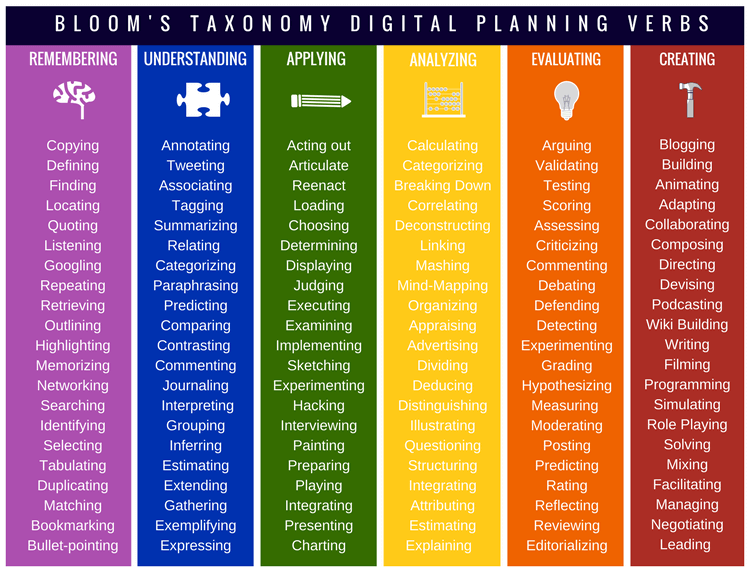
Bloom’s Taxonomy is a tool that you can use to help determine the levels of thinking you’re asking students to do, from simply remembering to understanding to applying and creating. This can give you insight into how to assess student learning and how to push students in higher-order thinking. Building upon each level in your lesson plans will guide students to think in increasingly more sophisticated ways.

I’ve used Bloom’s Taxonomy for years and have always found it helpful, but when I went looking for resources to share with my students I was surprised at how many videos and articles implied that teachers should include every level of Bloom’s Taxonomy in all of their lesson plans.

NOT TRUE!

How should you use Bloom’s Taxonomy in lesson planning?

One way is to think about the learning objectives for your lesson. What are you asking students to do, and what do you want them to be able to do at the end of the lesson? It can be helpful to see how your learning objectives align with Bloom’s Taxonomy by looking at the planning verbs below, NOT to make sure you’re hitting every level (not every skill needs to be taught and assessed at every level), but to help make you aware of what level of the taxonomy your lesson is hitting.

For example, if you are always asking students to identify and define key terms, you might want to think about ways to help them learn to apply those terms. Students may be able to define the parts of speech, but are they then able to use them in a sentence? Students may be able to identify examples of characterization and setting in a piece of literature, but are they able to create their own characters and describe the setting in their stories?

I’ve included a table of helpful planning verbs below. You can also download a free planning table HERE.

Teach with Puzzles: 5 Free Puzzle Creation Tools for Teachers

Most teachers have used puzzles in their classroom at one time or another, but did you know that puzzles are not only engaging, but beneficial learning tools?

Puzzles strengthen the connections between brain cells, and create new connections for improved cognitive speed. 

Puzzles require students to see things simultaneously in terms of parts and wholes. They require both logic and creativity. As different regions of the brain work together to achieve the best results, the brain trains itself to integrate different types of thinking for long-term benefits.

The following free tools and resources can help teachers make their own puzzles, from word search and crossword puzzles to jigsaw puzzles and secret codes.

Discovery Education Puzzle Maker

https://puzzlemaker.discoveryeducation.com

Instant Online Puzzle Maker

https://www.puzzle-maker.com

Crossword Puzzle Maker for Teachers

https://worksheets.theteacherscorner.net/make-your-own/crossword

Free Puzzle Piece Template at Teachers Pay Teachers

https://www.teacherspayteachers.com/Product/Free-Puzzle-Piece-Templates-Creative-Clips-Digital-Clipart-707940

Free Puzzle Decoder Wheel

https://www.teacherspayteachers.com/Product/FREE-Puzzle-Decoder-Template-Set-Zip-A-Dee-Doo-Dah-Designs-3434484

Intrinsic vs. Extrinsic Motivation

Too much of teaching is based in the carrot vs. the stick mentality: reward vs. punishment, neither of which is an effective tool for motivation and both of which are extrinsic, or external.

For example, if you’re sitting in your room or apartment and it’s messy, you might decide on your own to clean it up. Maybe you’re tired of living in a messy environment, or maybe you just want to do something to get going. You spend several hours cleaning and organizing and when you’re done it feels great. Just the internal satisfaction of doing a difficult task and then enjoying a clean room gives you a hit of dopamine, which makes you more likely to engage in this behavior in the future.

However, if you are compelled to clean your room by somebody else, either through punishment (a threat: clean your room or else…) or a reward (i.e. money), you may complete the task, but rather than experiencing internal satisfaction, you are more like to experience either resentment (if you’re doing it to avoid punishment), or entitlement (if you’re doing it for an extrinsic reward). Neither of these feelings will change your habits for the better. In fact, research shows that people who are paid to complete a task often perform more poorly than those who are not (see Daniel Pink’s Drive).

For teachers, we have to find a way to build up our students sense of intrinsic satisfaction for completing a task. In future blog posts I’ll explore ways of doing this, but for now know that threatening punishment, or offering a reward (for teachers this is often candy or a class party) are not effective incentives or motivators over the long term.