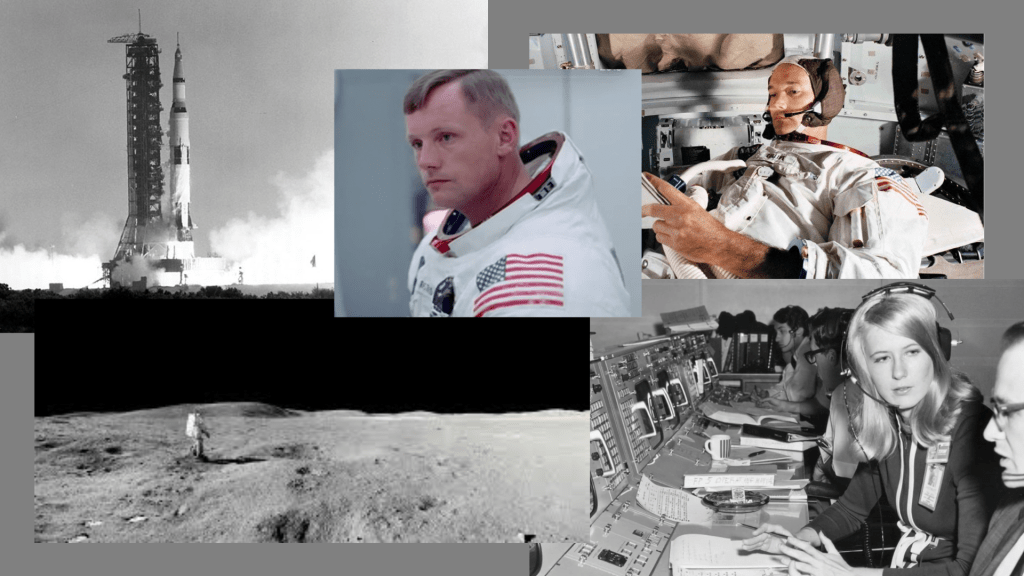
Happy Apollo 11 Day to those who celebrate it! July 20th, 1969
I’m not a science teacher or a history teacher, but I love the power of words and imagery and storytelling. I’ve always been fascinated by the space program and jealous of science and social studies teachers who get to teach it. I’m currently working on an essay about the Apollo program and being a first generation college student, and I have an idea for a novel about the discovery of Pluto.
We need to spend more time celebrating the effect storytelling has on our brains and our psyche. I believe it’s a valuable tool for writers, teachers, educators, parents, and everyone.
John F. Kennedy understood the powr of storytelling when he made the following speech at Rice University:
“But if I were to say, my fellow citizens, that we shall send to the moon, 240,000 miles away from the control station in Houston, a giant rocket more than 300 feet tall, the length of this football field, made of new metal alloys, some of which have not yet been invented, capable of standing heat and stresses several times more than have ever been experienced, fitted together with a precision better than the finest watch, carrying all the equipment needed for propulsion, guidance, control, communications, food and survival, on an untried mission, to an unknown celestial body, and then return it safely to earth, re-entering the atmosphere at speeds of over 25,000 miles per hour, causing heat about half that of the temperature of the sun–almost as hot as it is here today–and do all this, and do it right, and do it first before this decade is out–then we must be bold.”
~John F. Kennedy, Rice University, September 12, 1962
If you’re interested in teaching students about the space program, here are a few resources:
JFK’s speech at Rice (from Historic Speeches, and amazing resource):
Setting a daily intention gives focus to your day. I recommend keeping a journal, which also gives you the opportunity to reflect on where you’ve been and where you’re going. It helps to priortize your day and not let the day get away. Your daily intention should be both small and specific, like “I will read for twenty minutes,” or “I will drink 24 oz. of water.”
Read books
Reading improves your focus and memory, and it also gives you a window (or doorway!) to another world, and insight into another person’s experiences. It can not just make you more knowledgable, it can also make your more empathetic.
More importantly, I find reading to be highly motivating. Whenever I’m learning a new topic or need to accomplish a difficult task, the first thing I do is look for books about it. When I’m depressed, anxious, or struggling with something, a visit to the library or bookstore is motivating and renewing for me. Just smelling books makes me happy.
While I adore my Kindle (I have the e-reader that is a single use device, rather than a tablet) and buy more books than I’d like to admit on Amazon, nothing makes me happier than a visit to a bookstore with a coffee shop. If you’ve never done this, or haven’t done it in a long time, please make time to enjoy a coffee or tea while browsing for books. OR, just as good, buy a new book in a bookstore or get a fresh book from the library, and take it to a coffee shop.
Keep a to-do list
This summer, I’ve really noticed how much my productivity suffers and my anxiety skyrockets when I don’t keep a to-list. For me, the best way to conquer anxiety is to write down everything I have to do. I usually do a brain dump, followed by a big master to-do list, followed by scheduling the week’s priorities in my planning calendar. I’ve also seen people use post-its, or programs like Trello to keep and organize their to-do lists. I’d love to hear about your favorite method!
Practice gratitude
I was always dubious about this one until I started practicing it regularly. For me, I write down five things I’m grateful for every night before I go to bed. I really helps me shift my focus before going to sleep, and it has allowed me to see more positives than negatives in my life and in the world around me. For people who believe in manifesting, it can also be a way to manifest more positive events. Try for it at least a week and I promise you’ll see results.
If you’re thinking of becoming a content creator or looking into creating an online course, it can be difficult to know where to begin. Here are some fun and interesting niches that have been shown to be both fun and lucrative.
Effective Communication Skills: Teach techniques for enhancing interpersonal communication, public speaking, and effective writing.
Effective Time Management: Provide strategies and techniques for maximizing productivity, setting goals, prioritizing tasks, and overcoming procrastination.
Introduction to Creative Writing: Foster creativity and teach the fundamentals of storytelling, character development, and narrative structure.
Introduction to Mindfulness and Meditation: Provide guidance on mindfulness practices, meditation techniques, and stress reduction methods.
Practical Personal Finance: Offer lessons on budgeting, saving, investing, and financial planning to help individuals improve their financial well-being.
Introduction to Coding and Computer Programming: Introduce the basics of coding languages and computer programming, catering to beginners with no prior experience.
Nutrition and Healthy Eating: Educate participants about balanced diets, nutritional guidelines, meal planning, and healthy cooking techniques.
Introduction to Entrepreneurship: Guide aspiring entrepreneurs on developing business ideas, conducting market research, creating business plans, and understanding startup essentials.
Introduction to Psychology: Explore fundamental concepts of psychology, including human behavior, cognition, motivation, and mental health.
Introduction to Graphic Design: Teach the basics of graphic design principles, tools, and software to help participants create visually appealing designs.
Introduction to Photography: Help participants improve their photography skills by covering topics such as composition, lighting, and post-processing techniques.
Introduction to DIY Home Improvement: Teach practical skills for basic home repairs, maintenance, and improvement projects.
Introduction to Yoga and Flexibility: Introduce different yoga poses, stretching exercises, and routines to enhance flexibility, strength, and overall well-being.
Introduction to Art History: Take participants on a journey through different artistic movements, exploring famous artworks and their cultural significance.
Introduction to Sustainable Living: Educate individuals about sustainable practices, eco-friendly living, waste reduction, and renewable energy sources.
Brain dumping is a technique that involves taking all the thoughts, ideas, tasks, and information swirling around in your mind and transferring them onto paper or a digital document. It’s a way to externalize and organize your thoughts, essentially emptying your brain of its clutter.
The process of brain dumping typically involves writing down or typing out everything that comes to mind, without any specific order or structure. You simply let your thoughts flow freely, capturing them on paper. The idea is to create a comprehensive list or document that encompasses all your mental clutter.
The benefits of doing a brain dump are numerous:
Mental clarity: By externalizing your thoughts, you can clear mental space and gain a clearer perspective on your ideas and tasks. It helps reduce mental clutter and allows you to focus better on the things that matter.
Stress reduction: The act of transferring your thoughts onto paper can be cathartic and provide a sense of relief. It can alleviate anxiety and stress by unburdening your mind from constantly trying to remember or juggle multiple thoughts simultaneously.
Enhanced organization: Brain dumping allows you to capture all your thoughts and tasks in one place. This makes it easier to identify priorities, create to-do lists, and organize your ideas. You can then review and categorize the information, leading to better planning and improved productivity.
Idea generation: When you have a multitude of thoughts floating in your mind, it can be challenging to connect the dots or see the bigger picture. Brain dumping can help you identify patterns, make connections between ideas, and spark new insights and creativity.
Improved memory: Writing things down helps solidify information in your memory. By capturing your thoughts on paper, you create a reference point that you can revisit later, reducing the need to rely solely on your memory.
Problem-solving: Brain dumping can be an effective problem-solving tool. By getting everything out of your head, you can examine your thoughts and challenges more objectively. This external perspective often leads to fresh insights and potential solutions.
Overall, brain dumping is a valuable technique for decluttering your mind, gaining mental clarity, and improving your overall productivity and well-being. It’s a simple and accessible method that can be tailored to individual preferences, whether through traditional note-taking, digital tools, or even voice recording.
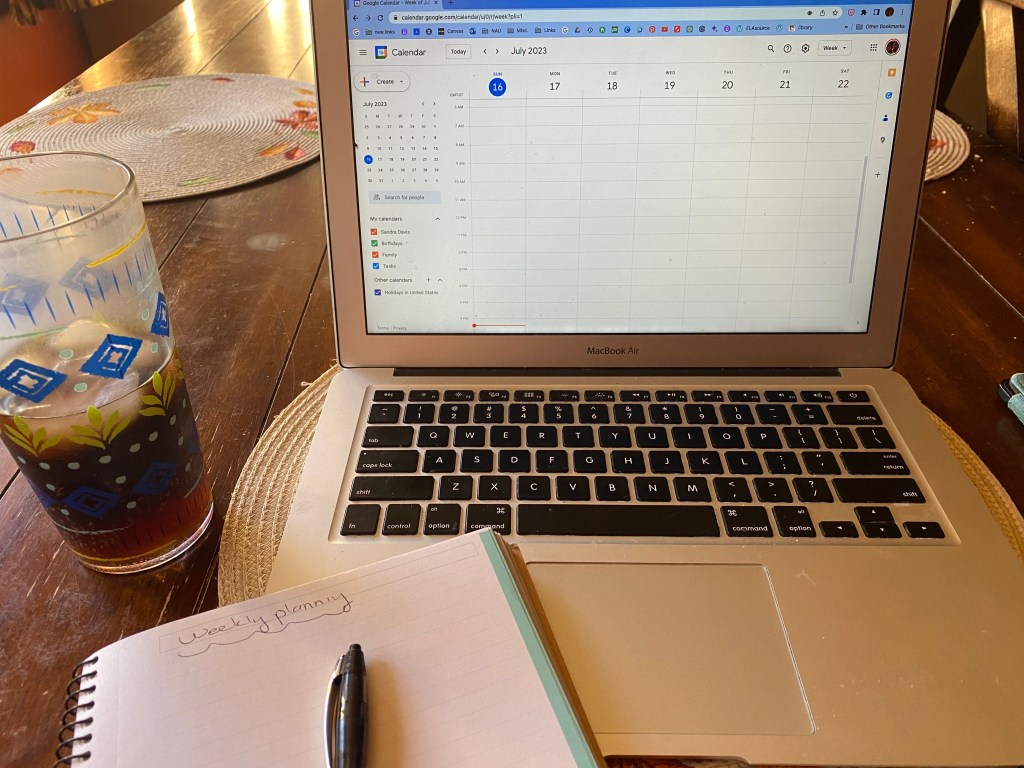
I discovered a few months ago that the cure for the Sunday Scaries (Sunday night anxiety) is to plan for the coming week. I’m usually too anxious to enjoy Sunday afternoons anyway, and this gives me an outlet for my restlessness and allows me to sleep better on Sunday night. It also makes the work week go much more smoothly.
Right now I’m on summer vacation, but I’ve realized that the first week of school will be here before I know it (sorry), and I want to get a jump on planning for the coming year. I also have personal projects that I want to complete before my semester begins (mainly my novel), so I’ve decided that since we’re done traveling for the summer I’m going to try to give my days a bit more structure by creating a very loose schedule and writing down some goals.
Research shows that people who WRITE DOWN THEIR GOALS and MAKE A PLAN, are much more likely to accomplish those goals.
I’ve been reading some productivity books and blogs, and one of the number one recommendations is to put your to-list into your calendar. SCHEDULE YOUR TO-DO LIST. Although I’ve always kept a paper calendar, I’ve decided to give Google Calendar a try. Before creating my schedule, I’m going to a brain dump. I’ll write more on doing a brain dump tomorrow, since that turns out to also be the first step in creating an online course.
Happy Sunday night and happy planning! Here’s to a great week.
I’m in the process of learning how to create online courses for the general public. I’m currently taking a Udemy course called “How to Create In-Demand Online Courses.” This is to learn how the nuts and bolts of creating an online course, but will also benefit me in my professional life, since as a professors I also teach an online course. I’m hoping to both improve as a teacher and a content creator, but also pass along that knowledge to you.
As a full-time college professor, former middle school and high school teacher, and someone who has a doctorate in curriculum design and is in the process of learning game design and digital marketing (as fun hobbies, lol), I feel uniquely qualified to help you on your journey to becoming a better teacher or content creator, or to get started on a side-hustle.
One of my biggest frustrations as a newbie content-creator is that so many of the resources out there are loaded with generic bullshit, click bait, and useless platitudes. For example, many of these resources will tell you to “choose a niche” or “know your audience” without really giving you the nitty gritty details of HOW to do that.
That’s why I’m doing a fun experiment and bringing you along for the ride. I’m going to explore several different types of content creation, from blogging to YouTube to TpT (Teachers Pay Teachers) to Fiverr and walk you through the step-by-step details of EXACTLY what I’m doing, how it’s going, what’s working and not working, and how to see results.
In addition to doing 30 days of blogging (which I’ll report on soon), I’m also learning how to create a course and then I’m going to create a post a course. Today I’m going to learn from Udemy and several other online resources, and then tomorrow I will start creating my course.
I would LOVE to hear suggestions for things you’d like to see me build a course on. Taking into consideration my experience and expertise, some options are:
In the last few days online (I’ve been on vacation and completing vegging), I’ve discovered an amazing array of talented people who vary widely in terms of abilties, age, privilege, and attractiveness. They have all gone “viral” in some way or another and have all been wildly succesful in terms of getting attention and making money (if either of those are your thing).
They include:
A woman who just published her first book at age 58 and is rewarding herself with a solo trip to the Galapagos islands.
A woman in her 60s who is brand new at cycling and just cycled 250 miles with her son.
A woman who creates Tik Tok livestreams in which she acts like an NPC and pops corn using a hair straightener.
A woman who is not conventally attractive or rich or privilged (bascially a nobody) who has a wildly successful podcast in which she interviews celebrities. She has only posted 9 episodes! Her unique approach is to be really, really bad at interviewing. People love her!
A little old man who livestreams himself eating his lunch.
WHY have I included these examples?
Because you can do anything you want.
I repeat: YOU CAN DO ANYTHING YOU WANT!
I grew up in the 70s and 80s and was an adult in the 90s. It was a time when gatekeepers had all the power. I was told I couldn’t be a writer, a photographer, or a playwright. Back then, when there was no internet, you bascially had to be independently wealthy to pursue those dreams. Instead, I became an English teacher, which I LOVE, and since then, with the rise of the internet, then Web 2.0 and interactive digital media, social media, and creative sharing sites like YouTube, you can do anything and be anything.
IT DOES NOT MATTER:
How old you are.
How much you weigh.
How attractive you are.
Where you starting from.
Right now, I want you to spend a few minutes thinking about and reflecting on what you’d like to do and who you’d like to be, WITH NO LIMITS.
I’ll start first. I’m 52 years old and I’m writing my first novel. I want to finish it (it’s HARD work) and I want to sell it. I want it to become a best seller and I want to make a ton of money off of it. This is actually possible, and if I don’t sell it, I will publish it myself on Amazon, which writers can now do for free.
There are many reasons for this, which I list below. First of all, if you are a teacher, it’s okay to fantasize about leaving your profession. Teachers are not paid well or treated well, and there is no shame in leaving YOU are not the problem.
And even if you keep teaching, having a side hustle will make a you better teacher. This has been the case for me. In trying out and creating several different side hustles (mainly TpT and Fiverr), I have learned a lot about myself as a teacher, and a lot about creating engaging content. As a result, my lessons, assessments, and overall approach to teaching have gotten better, which has been a benefit to both me and my students.
Teaching is undoubtedly a noble profession that plays a crucial role in shaping the minds and futures of young individuals. However, the demands of the job can sometimes leave teachers with limited time and financial resources. In recent years, many teachers have turned to side hustles as a way to supplement their income, pursue their passions, and gain valuable experiences outside the classroom. In this blog post, we will explore why teachers should consider having a side hustle and how it can bring numerous benefits to their personal and professional lives.
If you’re here as a writer, someone in another profession, or as a stay-at-home mom, finding a side hustle and creating content will change your life for the better.
I’m going to help you get started.
What creating content and making money online can provide:
Financial Stability and Flexibility
While teaching is rewarding in many ways, it’s no secret that the pay scale for educators may not always reflect the hard work and dedication they put into their profession. A side hustle can provide an additional source of income, allowing teachers to better meet their financial needs and alleviate any financial stress they may experience. Whether it’s tutoring, freelance writing, or offering online courses, a side hustle can contribute to greater financial stability and flexibility.
Pursuing Passions and Talents
Teaching is a multifaceted profession, and educators possess a wide range of skills and talents beyond their classroom expertise. A side hustle presents an opportunity for teachers to explore and monetize their passions. Whether it’s photography, graphic design, crafting, or playing a musical instrument, a side hustle can serve as a platform to showcase and develop these skills. Not only does this enhance personal fulfillment, but it can also inspire creativity and bring a renewed sense of purpose to teaching.
Professional Growth and Skill Enhancement
Engaging in a side hustle outside of the teaching realm can lead to professional growth and skill enhancement. It allows teachers to gain valuable experiences that can be applied in the classroom, fostering innovation and fresh perspectives in their teaching practices. For instance, starting a blog or YouTube channel can hone communication and technology skills, while running a small business can develop entrepreneurial acumen. These transferable skills can ultimately enhance the quality of education provided to students.
Networking and Building Connections
Side hustles often require teachers to interact with a diverse range of individuals and communities. This presents an excellent opportunity to expand their network and build connections outside of the education sector. Networking can lead to collaborations, mentorships, and new career possibilities. Moreover, connecting with professionals from different fields can expose teachers to alternative perspectives and innovative ideas, enriching their teaching methods and broadening their horizons.
Work-Life Balance
Balancing work responsibilities with personal life can be a challenge for many teachers. Engaging in a side hustle can actually contribute to a healthier work-life balance. While it may seem counterintuitive to take on additional work, a side hustle that aligns with personal interests and allows for flexible scheduling can provide a welcome break from the demands of the classroom. By dedicating time to their passions outside of teaching, educators can rejuvenate their energy and bring fresh enthusiasm back into their classrooms.
Conclusion
As we all continue to face financial constraints and seek personal and professional fulfillment, having a side hustle has become an appealing option. Whether for financial stability, pursuing passions, professional growth, networking, or achieving a better work-life balance, anyone can benefit greatly from the diverse opportunities and experiences that a side hustle offers. By embracing a side hustle, educators can enhance their well-being, broaden their horizons, and ultimately become even more effective and fulfilled in their role as teachers.
I am creating guides to start making money right away on Teachers Pay Teachers, Fiverr, Udemy, and Twitter. Let me know in the comments what you need and what you’re most interested in learning about.
I’ve recently started working on prep for a free online course (Coming Soon!) and for my fall classes, and I wasn’t happy with most of the course planning or unit planning guides I found online, so I created my own. I’ve included it here as a printable PDF and also a fully editable MS Word Document. Feel free to take this and use it any way you like!






 ELA Source
You must be logged in to post a comment.