How Teachers Can Make Money Online

If you are a teacher and you want to make money online, for any reason, you absolutely can. Normally, I am skeptical of get rich quick schemes, and for a long time I was of the mindset that there was no way to make money blogging–that ship had sailed. I’ve recently learned that I was dead wrong. Not only can teachers make money online, but there are now more ways than ever to make almost any amount, from lunch money to creating a second income.

An article from Forbes Magazine lists 12 ways to make money online, but I’ve narrowed this down to the ways that are most relevant for teachers, and I will be writing in-depth articles on these in the weeks to come, along with my experiences.

Here are some ways teachers can make money online:

  • Blogging: This method can still earn money through advertising, affiliate marketing, and sponsored posts
  • Creating and selling products on Teachers Pay Teachers
  • Creating a newsletter or podcast
  • Writing and selling ebooks
  • Consulting
  • Webinars or Courses: These can be managed using sites like Udemy or Teachable

The Forbes article goes into much more depth about each of these methods (except Teachers Pay Teachers), but as I said, I will be exploring each method in greater detail on this site, with how-to-get-started guides and helpful links, along with reflections on my own experiences.

A New Model for Writing Instruction

Good writing is not just correct writing. If that were true our jobs as writing teachers would be must easier. Writing is composing. We don’t expect a budding musician to pick up an instrument and begin composing. First, a new musician has to learn how to read music and play the instrument.

This takes years.

We expect it to take years. The new musician has to listen to and learn to play dozens, even hundreds of already existing pieces, while receiving immediate feedback and constant corrections during the process. Corrections in posture, hand position, pacing, etc..  Only after mastering this process can a musician being to learn how to compose small pieces.

Also, even the most experienced musicians have teachers and coaches who provide feedback. Musicians are constantly honing their technique. They expect and even desire feedback.

None of this happens in writing instruction.

Often times we expect students to master the essay form, a beautiful and complex form in its own right, after just one lesson. Sometimes after no instruction at all, just a prompt and a list of requirements.

With writing, we expect students to master writing after one school year, or one semester, or even after one or two assignments, often with minimal feedback from their teachers. Teachers can get angry if they have to tell a student more than once how to use a comma, when a piano teacher knows she will stand by her student and correct her hand position constantly. This is even true of experienced musicians.

I propose a new model of writing instruction, one that focuses more on long-term mastery, teaching specific techniques (such as the selective use of detail or dialogue) rather than assigning one essay after another, providing on-going low-stakes feedback (low-stakes meaning their grade does not depend on it), and creating a culture in our writing classrooms in which students rely on and desire feedback from their instructors and peers.

To find out more about what this technique looks like in the classroom, please follow this blog as I explore this idea in more depth in future posts and provide lessons and resources to implement this new model in the classroom.

Increase Your Productivity with the Pomodoro Technique


A quick way to boost your productivity and get things done is to experiment with the Pomodoro Technique. The Pomodoro Technique is a type of work sprint developed by Francesco Cirillo in the late 1980s based on the tomato-shaped kitchen timer used by Cirillo as a university student.

Five steps to implementing the Pomodoro Technique:

  1. Decide on the task that needs to be done. This can be done right before the Pomodoro or while making a to-do list in the morning or before bed.
  2. Set a timer. You do not have to use a fancy little tomato timer–I use the one on my iPhone. A traditional Pomodoro is 25 minutes, but sometimes I’ll do 10-30 minute work sprints depending on my available time.
  3. Work on the task. Try to be as focused as possible by turning off notifications.
  4. When the timer goes off, stop and take a 3-5 minute break.
  5. Ideally, complete four Pomodoros in a row and then take a longer break of 15-30 minutes. However, if you only have a short time to work, do one Pomodoro or even a 10-minute

How to be a Better Writer in One Day

Reading Like a Writer

If you want to dramatically improve your writing ability the best way to take your writing to the next level is through the process of Reading Like a Writer.

I didn’t learn the concept of Reading Like a Writer until the second year of my MA program. My writing improved dramatically in one hour.

The basic concept of Reading Like a Writer is to read exemplars of the type of writing you want to do. In the MA class I was taking the professor pointed out that many writers and writing teachers don’t understand the concept of sentence variation and the importance of not only using a variety of sentence types and lengths, but tailoring your sentences using rhetorical decision making.

For example, a long, complex sentence followed by a short, punctuating sentence can have a greater rhetorical impact than two complex sentences back-to-back, in which the point of the first sentence is lost in the complexity of the second sentence. A short sentence can reinforce the point of the long sentence.

See what I mean?

The best part of Reading Like a Writer is that it’s simple and doesn’t require expensive books, curriculum, training, or materials. Simply find an example of what you want to write (an essay, a poem, an argument, a short story, etc.) and read it multiple times to analyze it, dissect it, and study it. In other words, figure out what make the writing tick.

What are it’s strengths? How does it capture and hold your attention? What specific  techniques does the writer use?

Tips for Reading Like a Writer:

1. Read often. Read widely.

Pay particular attention to the types of writing you are required to do in school or the types of writing you want to excel at. If you want to write excellent essays, read the best essays.

2. Practice close reading.

Close reading involves looking for techniques and patterns and analyzing. WHAT does the writer do? HOW and WHEN does the writer do it? WHY does the writer do it and what impact does it have on the reader?

3. Annotate and take notes, and discuss your findings.

Have everyone in your writing group (teachers can do this with peer groups) read the same piece and discuss the writing techniques in depth. This can be an excellent way to model and practice writing critiques in a peer workshop setting.

4. Practice the Techniques

This is the most important part. When you learn a new technique for introducing an essay, adding punchy dialogue, writing vivid description, using sentence variation, add more effective transitions, etc.; you must then practice them in your own writing. Not only does this allow you to practice and study the effectiveness of the technique, it also reinforces the concept and cements it in your long-term memory.

5. Get Feedback

After practicing, get feedback from your writing group or peer workshop group on how well you are mastering the technique and what you can do to improve.


How to Plan a Successful Unit

What Makes a Good Unit?
A good unit has five key elements:

1. A good unit engages the teacher.
Teach what you know, teach what you love, and find a way to put a positive spin on what you are a required to teach.

2. A good unit allows the teacher to participate as a learner.
For example, writing with your students, reading along with them (you might discover something new), or doing some research to discover something new about an old topic. Also, open yourself to learning from your students. In a constructivist approach to learning, we create new knowledge each time we teach a topic, and I find myself learning more and more each year from my students.

3. A good unit meets students’ needs and/or sparks their curiosity.
What helps drive this is a discovery approach to teaching and learning, as well allowing your students to have some autonomy in choosing topics and project types. Giving students a questionnaire or writing inventory can help you get to know your students; creating a classroom RPG or writing workshop can give your students more autonomy. Another approach is the differentiate your instruction by giving students choices of topics or methods for learning the same concepts and skills.

4. A good unit communicates clear goals and expectations.
Students respond well to teachers and curriculum which have a sense of direction and purpose, when activities align with the goals the teacher and the class, and when expectations are clear. Nothing is more frustrating to students than not knowing how to approach a project or why they are working on a particular task. Like adults, students do no enjoy doing busy work that seems meaningless. The goals and objectives should be shared with the students at the beginning of the unit, both orally (the teacher and the students can take turns reading these or read them together) and in print. A handout in their binder or classroom posters can help remind students of the goals and objectives of a particular project, but these should also be reviewed orally throughout the unit.

5. A good unit is organized and offers a wide variety of materials and methods.
Relying on a single book or textbook is boring for both the teacher and the students. If you are required to teach from a prescribed textbook or packaged curriculum, try to supplement with your favorite short stories, articles, essays, slide shows, music, video clips, and interactive activities.

How to Create a Student-Centered Writing Classroom

Even teachers who have little control over what they teach can infuse writing lessons with student choice and autonomy. This begins with putting student in a writing mindset in which they think they real writers with a real audience and purpose.

A real writer has their own favorite topics, ideas they are burning to write about, an audience they want to reach, stories they want to tell, and even deadlines they have to meet. Real writers have strengths and weakness and skill they need to improve along with talents they are proud of.

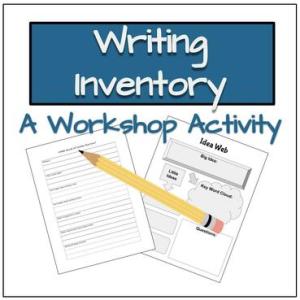
Begin your school year by having students take a writing inventory.

What is a writing inventory?

A writing inventory can consist of having students write about their strengths and weaknesses, what they like most about writing and what they struggle with, and ideas for things they would like to write about. These can be graphic organizers or just reflection prompts.

What ever writing inventory or inventories you end up using, consider taking an inventory along with your students and discussing your own writing preferences with them.